Tuesday, March 30, 2021

Audience research- Demographics
What are demographics?:
A set of objective characteristics that describe a group of people.
Characteristics include...:
- Age Most important
- Gender
- Class
- Ethnicity
- Sexuality
- location and sometimes...
- Education and lifestyle
- The Explorer: Driven by a need for discovery and/or challenge
- The Aspirer: Materialistic/ Care more about what others think.
- The Succeeder: Self Confidence/ Strong goal orientation/ Organised
- The Reformer: Values their own individual judgment/ Anti materialistic
- The Mainstream: Largest group/ core need is security/ Live in a daily routine.
- The Struggler: Seek escape/ Live for today few plans for tomorrow
- The Resigned: Aim to survive/ Predominantly older people
Thursday, March 18, 2021
Monday, March 15, 2021
Music video age rating research
https://www.bbc.com/news/entertainment-arts-32050068
"Fans watching music videos on YouTube and Vevo will be presented with cinema-style age certificates from Thursday."
This was a move from the government to make it so that music videos had to have age ratings on them to protect children after artists such as Miley Cyrus, Robin Thicke, and Rihanna brought out music videos below visual par and showing explicit content. This actually the second phase though and the first originating in October. The initial phase found that around 20% of music videos would be given a rating of 12,15 or even an 18+ rating. Examples of songs that were given ratings and what they are were...
- Kasabian - Stevie Released last October, the unsettling video for Stevie showed a young boy being raised as a test subject in a laboratory. It received a 12 certificate for "moderate threat".
- Dizzee Rascal - Couple of Stacks The video for Dizzee Rascal's last single was graphic enough to earn an 18 rating. The BBFC cited the video's "strong bloody violence, gore [and] very strong language" in its ruling.
- Prides - I Should Know You Better Shot in Scotland, the video for Prides' synthpop single featured a "weird and sad tale of a nice yeti just trying to get along in life" until a hunter cuts his life short. It was rated 12 for "moderate threat, violence, and sexual images."
During the first phase of the trial, 84 music videos were given certification. Of those, 27 were rated 12; 39 were rated 15, and only one was rated 18.
Six music videos submitted to the BBFC were classified U and 11 were classified PG.
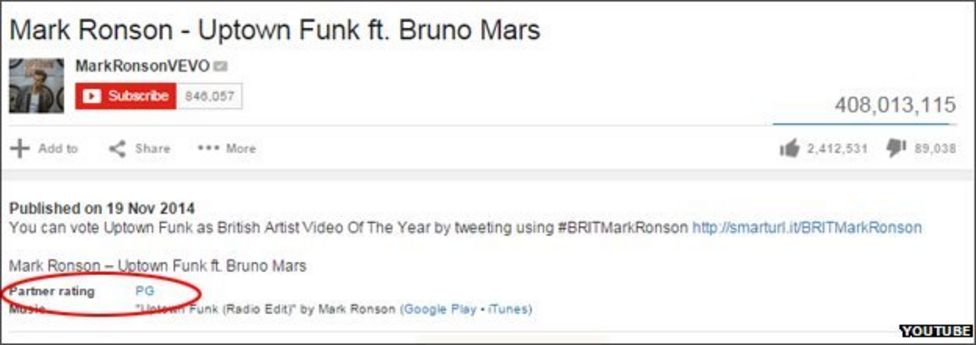
Once given an age rating, record labels pass on the guidance to the two digital service providers - Vevo and YouTube - who, in turn, display it when the videos are broadcast online.
There are no rules on how youtube needs to display this, but they have gone with a format like...
Popstar Annie Lennox was among those who called the imagery of certain videos "dark" and "pornographic".
"I'm all for freedom of expression," She told the BBC, "but this is clearly one step beyond, and it's clearly into the realm of porn."
As the trial scheme goes public, David Austin, assistant director of the BBFC said: "We hope this pilot will provide consumers with information to help guide them and their families when accessing music videos online.
"Parents taking part in our most recent review of the BBFC Classification Guidelines in 2013, expressed their concerns about the content of music videos online, in particular their role in the sexualization of girls and portrayals of self-harm, drug use, and violence in some music video content."
YouTube's Candice Morrissey added: "Over the last few months, we have been working with the UK's music industry to help them display the BBFC's age ratings on their music videos on YouTube.
"These are in addition to the controls we already provide on YouTube including the ability for uploaders to add age warnings to videos and a safety mode to help parents screen out content they do not feel is suitable for their children."
Here are some stats on the subject:
70% of parents of under 12s are concerned about their children being exposed to inappropriate content in music videos, up to 60% of children say they have seen content in online music videos of which their parents would disapprove, given the choice, 86% of parents would encourage/ensure their children watch online channels with clear age ratings,75% of parents would like online channels to link music video age ratings to parental controls.
David Austin, Assistant Director, BBFC said: “The research shows parents perceive age ratings for online music videos to be almost as important as ratings for film and DVD/Blu-rays. Parents want more nuanced guidance about the content of the music videos their children are accessing online, with BBFC age rating symbols alongside BBFC insight content advice being the preferred form of labeling."
Sony Music, Universal Music, and Warner Music will send videos to the British Board of Film Classification (BBFC) before putting them on YouTube and Vevo. There were 132 videos submitted and 56 were rated 12+, 53 were rated 15+ and only 1 was rated 18+
Thursday, March 11, 2021
Week 6: Music video brainstorm
Brainstorm:
Music Video Brainstorm by Grace Watson by gracewatson143Props and Costumes Checklist:
Props:
- Bible -> TBC
- Car -> Phoebe Armitage will be driving her own car.
- Orange umbrella -> TBC
- Landline phone -> already on set.

- Baking/cooking equipment (mom and daughter will be baking in the kitchen) -> I (Grace Watson) will provide this.


Tuesday, March 9, 2021
Target audience research
https://www.surveymonkey.com/results/SM-TF6YX8XL9/
Thursday, March 4, 2021
Artist and branding research:
7 Musicians who nailed their branding campaigns:
- Tailor Swift
- The 1975
- Paramore
- Slowthai
- Cristine and the Queens
- Ariana Grande
- Ed Sheeran
- Music videos can help convey an image in a more precise and slightly better way than trying to imagine for yourself. It can also help an artist create an image and brand for themselves, that's more clear than possible perceptions.
- Music videos are so powerful in some cases they can make or break a person's career.
- Videos are very important to artists as key to properly and effectively brand and gain a good following.
- Accessibility is massive, which was one thing that MTV lacked as it was only who they set but now anything accessible to.
- The ability for people now to search up and watch as much as they want of somebody's music video whenever they are in the mood, ingraining that image and sound into the viewer's head.
- Consistency is what ingrains these things into the mind rather than just watching it once or twice. This is linked to accessibility because it's so accessible people are constantly watching.
- "Accessibility leads to repetition, which helps develop a strong brand." Good quote.
- "The unlimited access to the Internet magnifies everything that goes into an artist’s image. Artists need to be extremely mindful of their look and feel down to every last piece of clothing." This shows how much effort actually goes into an artists image so that people get the right idea of them because humans literally look into everything that's in from of them, so if you do something for a video you need to show exactly what you trying to get across otherwise people may get the wrong idea of you.
- Music videos allow up-and-coming artists to keep up with what they are doing on a constant basis, whereas for already established artists it is a way to keep adding to their image in a way that doesn't take extensive uses of marketing.
- "For example, Wiz Khalifa has taken his homegrown marijuana-loving rap fan-base and expanded that greatly across all demographics. This was in large part achieved by performing with the internationally known band Maroon 5 in their video “Payphone.”" This greatly widened his demographic and gave him a larger and more diverse brand and image, not just known for his weed-loving antics. Also, the video greatly added much more impact, as it may and probably wouldn't have changed his brand image or increased his demographic either.
- "The “Payphone” video, released 4 months ago, has had more than 60 million views. That is 60 million people seeing Wiz as a pop act rather than just a hip-hop artist. And, for a catchy song like this, people are going to keep coming back to the same video to hear the song and see Wiz and his brand in this capacity." These stats show how much success one music video can change an image.
- "The accessible nature of the web compliments an artist like Wiz who constantly is putting out video content. Wiz is an ideal example of an artist who took advantage of the web and its all-access nature, and flooded his fans with content, which has lead to the success of his brand." Good point.
- Shareability This is a massive thing for artists as they need this as a massive way in order for them to get noticed. The ability to share with others has become a massive widespread phenomenon and allows artists to really take control of their brand and image and giving them the power to share things with millions of people on a day to which they couldn't do just as early as 10 short years ago.
- Commenting coming in with the whole sharing craze has made things even easier to do new things. "Justin Beiber’s latest video “As Long As You Love Me” was geared to introduce his evolving brand into the adult world. It is a mini-movie where the father of the girl he is pursuing beats him up. Beiber performs with bruises all over his face. This image is something completely new for the teen icon, and almost jarring to see as he gets punched repeatedly in the face. Bieber is at the point in his career where he needs to make the jump to the adult audiences and this video is intended to be a vessel to accomplish that quickly. The shareable nature of the web and social media had millions of people seeing the “new” Bieber within days." This made comments spread so rapidly that in just a short amount of time Justin Beiber had gone from a teen pop kind of artist into something for more adulty in genre.
- "The branding power of the web may still be well undervalued as less money is spent now on music videos than in prior times.", "Branding on the web is a double-edged sword, however, since if it is not done in the right way, it can hurt an artist’s career just as fast as it can help it." These points really sum this up well.




Wednesday, March 3, 2021
Steven Archer & Andrew Goodwin Theories
Steven Archer:
Steven archer is a media theorist mostly known for his article in the music magazine in 2004 which he detailed some of the key components for making an attention-grabbing music video how producers do this to draw the attention of their viewers.
Archer believed that essentially a music video should pretty much build on and enhance the experience that the viewer is getting through the music. Archer also believes that a visual representation is the best way to re-engage a viewer when the actual music itself is unsatisfactory. Archer believes that a music video is also another marketing strategy for the music to make it more appealing. He also believes that CDs and performances, e.g. Concerts, touring performances, etc... appeal to the wider majority of audiences and appeal to the fan's fetishistic intentions to consume as much media as they can.
Steve archers 5 key points:
- 'Thought beats' or the visualization of imagery through synesthesia
- Narrative and performance
- The 'star image'
- Illustration, Amplification, and disjuncture.
- Technical aspects
https://www.slideshare.net/SuperDrNerd/steve-archer-music-video-theory-54360498 This is where I got my research from.
Andrew Goodwin:
Andrew Goodwin believed that all music videos portrayed genre characters. Goodwin thought that lyrics and music video visuals connotated very closely. The visuals need to either match the lyrics in an illustrative, amplifying, contradicting, or disjuncture way.
Meanings of each of these things are:
Illustrative- When the music video is representing literally what the lyrics are saying
Amplifying- The repeating of key meanings to manipulate the audience
Contradicting- Where the video is contradicting to the music and lyrics.
Disjuncture- When the video has nothing to do with the lyrics and song.
The whole entire mood, tone, and atmosphere created by the music must match the visuals in either a contradicting, amplifying, or illustrative manner.
Some information taken from https://gracecwatson.blogspot.com/
Tuesday, March 2, 2021
Tuesday 2nd of march classwork: Demi Lovato & Sam Fischer Research:
Demi Lovato:

Tuesday 2nd March classwork:
Music Video Notes/ Tips:
- Always have a few different locations, inside/outside, whatever.
- Always have one base performance shot that you can use anytime if needed.
- You can use many different ways of holding the camera, tripod, handheld, etc...
- Throughout the shoot have the song you are using running over the video while performing the music video. And have the performer lip-sync to the song or even just sing along.
- Rather sing-along than lip-sync to a song as it is more realistic that way whereas lip-syncing can look fake and forced.
- You don't need to create a great audio recording of the singing as it will be covered by the song during the editing process.
- Make sure you have synced the audio with the video very well.
- Make sure to have continuous shots.
- Also, it's nice to add color grading to the end of your videos.
Post-Prelim work Thursday:
Article #1- TheSpinoff Notes: Confronting new research shows just how fast traditional media lost young NZ. Over the last 10 years, we h...

-
Hi, I'm Arden Lee by Hunter Look
-
The 17th film within this particular franchise of superhero movies. Marvel Studios is a subsidiary of Disney (one of the largest conglomera...
